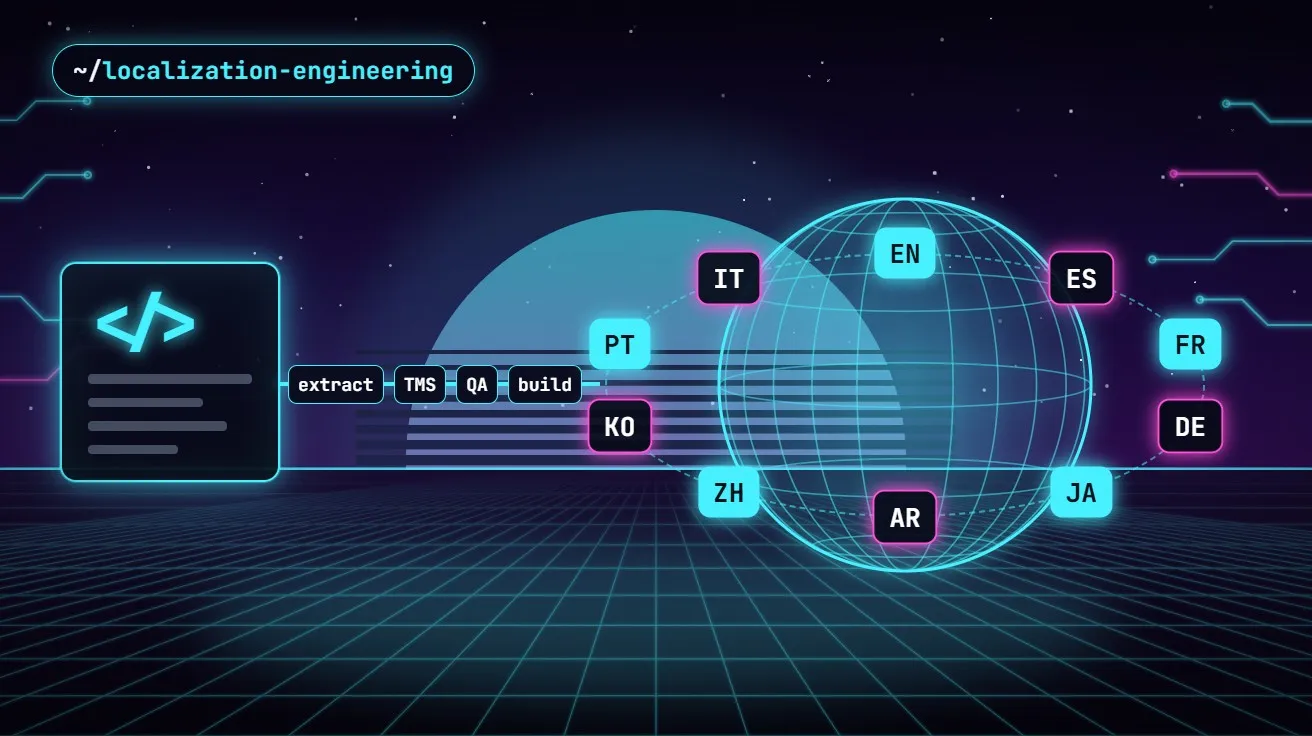
Localization engineering is the technical work that lets a product exist in many languages without breaking. This is what the job looks like from the inside.
When people ask me what I do, the short answer is: I make sure nothing breaks on the way from the people who write content to the people who read it in their own language.
The long answer needs a bit more space. I started as a translator and software localizer, moved into engineering, and today I lead a localization engineering team. This is the explanation I would have liked to read when I started.
What localization engineering is
Localization engineering is the technical discipline behind multilingual products. A localization engineer takes content in whatever shape it arrives (a JSON bundle, an XML export, a DITA map, an InDesign file), prepares it so translators can work without breaking it, connects the systems it moves through, automates the repetitive parts, checks the result and puts the translated content back so the product works in every language.
Translation is the part everybody sees. Localization engineering is everything that has to go right before and after it.
What a localization engineer does all week
A normal week, more or less in the order things happen:
- Preparing files. Working out what in a file is translatable and what is code, placeholders or markup that must survive untouched. Then extracting exactly that, nothing more and nothing less.
- Building kits. Packaging the content with what translators need: context, screenshots, instructions, glossaries, character limits.
- Configuring tools. Creating projects in the translation management system (TMS), attaching translation memories and termbases, and tuning file filters and segmentation rules so translators see clean, complete sentences.
- Automating. If a task happens twice, it becomes a script. Regular expressions, Python and APIs remove manual steps, and most human errors go with them.
- Integrating systems. Connecting a CMS or a Git repository to the TMS so new strings go out for translation on their own and come back without anybody copying and pasting.
- Running QA. Automated checks for broken tags and placeholders, inconsistent terminology or encoding problems, plus file validation before anything reaches a build.
- Troubleshooting. “The file won’t open.” “The formatting is gone.” “The app shows question marks.” Finding the root cause is a big part of the job, and still the part I enjoy most.
- Putting it all back. Importing translations, building the localized product and checking that every language displays and behaves correctly.
- Answering questions. Technical ones from translators, internationalization ones from developers, and “can we have this by Friday?” from everyone else.
When it works, nobody notices. Translators translate instead of fighting the tools, developers ship without worrying about translations breaking the build, and project managers can promise dates. When it doesn’t work, everybody notices at the same time.
Who you work with
The role exists because every group involved speaks a different language, and I don’t mean English or Spanish.
- Developers want translatable content extracted and reintegrated without side effects in their code.
- Translators want context, decent tools and someone who fixes technical problems quickly.
- Project managers want predictable workflows and early warning when something is going to slip.
- Clients want a product that works in every language, and someone who can explain a technical trade-off in plain words.
That last one is underrated. In escalations and customer calls, the localization engineer is often the person who turns a technical root cause into a decision somebody can actually make.
The skills that matter
Technical skills
- Scripting. Python, mostly, plus PowerShell or Bash and solid regular expressions. You do not need to be a software engineer. You do need to be comfortable automating your own work.
- File formats. XLIFF, XML, JSON, YAML, PO, RESX, DITA, HTML, and the quirks of each: how to parse them, convert them and change them without breaking them.
- Character encoding. Knowing why text turns into
éor�, and how to stop it, is not optional. - APIs. Modern workflows connect systems through APIs: CMS to TMS, TMS to machine translation, repositories to builds.
- Version control. Working in developers’ Git repositories is part of the job now.
Tools
| Category | Examples | What it’s for |
|---|---|---|
| Translation management systems | XTM, Phrase, memoQ Server, Wordbee, Smartling | Projects, workflows, automation, integrations |
| CAT tools | Trados Studio, memoQ, OmegaT, Passolo | Translation memories, termbases, filters, segmentation |
| QA tools | Xbench, Verifika, built-in checks | Tags, numbers, terminology, consistency |
| Machine translation | DeepL, Google, custom engines, LLMs | Pre-translation and post-editing |
| Scripting | Python, PowerShell, Bash, regex | File preparation, batch work, reporting |
| Standards | XLIFF, TMX, TBX, PO, JSON | Moving data between tools and vendors |
Learn the concepts behind the tools rather than the menus. Menus change with every release. Segmentation, leverage, tag handling and file filters work the same way everywhere. If you like open source, I wrote about doing this work on Linux and about setting up OmegaT properly.
Everything else
- Problem solving. Most days involve finding out why something that worked yesterday doesn’t today.
- Communication. Explaining technical things to non-technical people, and business needs to technical people.
- Attention to detail. One stray semicolon can break a file in thirty languages.
- Organization. In a language service provider you will juggle a lot of projects at once.
- Language sense. Understanding text expansion, plural rules, right-to-left scripts or sorting helps you see problems before they happen. Many of us come from translation, and it shows, in a good way.
How the role appeared
Before the 1980s, localization was improvised: text was hard-coded and translators hunted through source code to replace it. Personal computers made international markets essential, software companies built localization teams, translation memory appeared and internationalization became a design principle. The web made every product global, and translation management systems became standard. Then neural machine translation, cloud platforms and continuous localization turned the job into a systems discipline that sits next to product and engineering.
What’s changing
- AI and large language models. Machine translation keeps improving, and LLMs now draft, estimate quality, extract terminology and check content. The interesting work for engineers is designing the workflows that decide what goes to a machine, what goes to a person and what gets both.
- Continuous localization. Content flows from repositories and CMSs to the TMS and back with every release, instead of in big batches.
- Internationalization earlier. Localization concerns get raised in design and code review, not after launch. Of all the changes on this list, this is the one that saves the most money.
- More formats. Video, subtitles, voice and synthetic speech bring new pipelines and new ways to break things.
There is always a pull towards the exciting part of all this. Most of the real work is still unglamorous: encodings, escaping, placeholders, segmentation, round-trip integrity. A workflow is only as good as the ugliest file it survives.
The hard parts
- Scale. More platforms, more languages, faster releases, same team.
- Speed versus quality. Choosing the right mix of machine translation, human review and QA for each type of content.
- Edge cases. Right-to-left languages, complex scripts, text expansion that breaks layouts, locale-specific sorting.
- Being brought in late. When localization joins at the end, every problem becomes urgent and expensive.
- Showing value. Turning “we automated this” into numbers leadership cares about. As far as leadership is concerned, what you cannot measure did not happen.
Questions I get asked a lot
Do localization engineers translate?
Usually not. Many of us come from translation, and that background helps a lot, but the job is preparing, automating, integrating and checking.
What is the difference between internationalization and localization engineering?
Internationalization (i18n) is designing software so it can be localized: externalized strings, Unicode support, locale-aware formatting. Localization engineering is making the localization happen efficiently, from file preparation to reintegration. The two overlap, and localization engineers end up reviewing i18n more often than you would think.
Do I need to know how to code?
You need to be comfortable with scripting and automation. Python and regular expressions take you a long way. Full software engineering is a bonus, not a requirement.
Is it a good career?
It is a niche, and its strategic weight keeps growing. Companies that ship in many languages need people who understand both language technology and systems, and that combination is still rare.
If you are working on a localization workflow that should be simpler, or you need someone who connects engineering, customers and teams, let’s talk. You can also try my free tools for localization engineers, like the Master File Validator or the Quick XLIFF Editor.