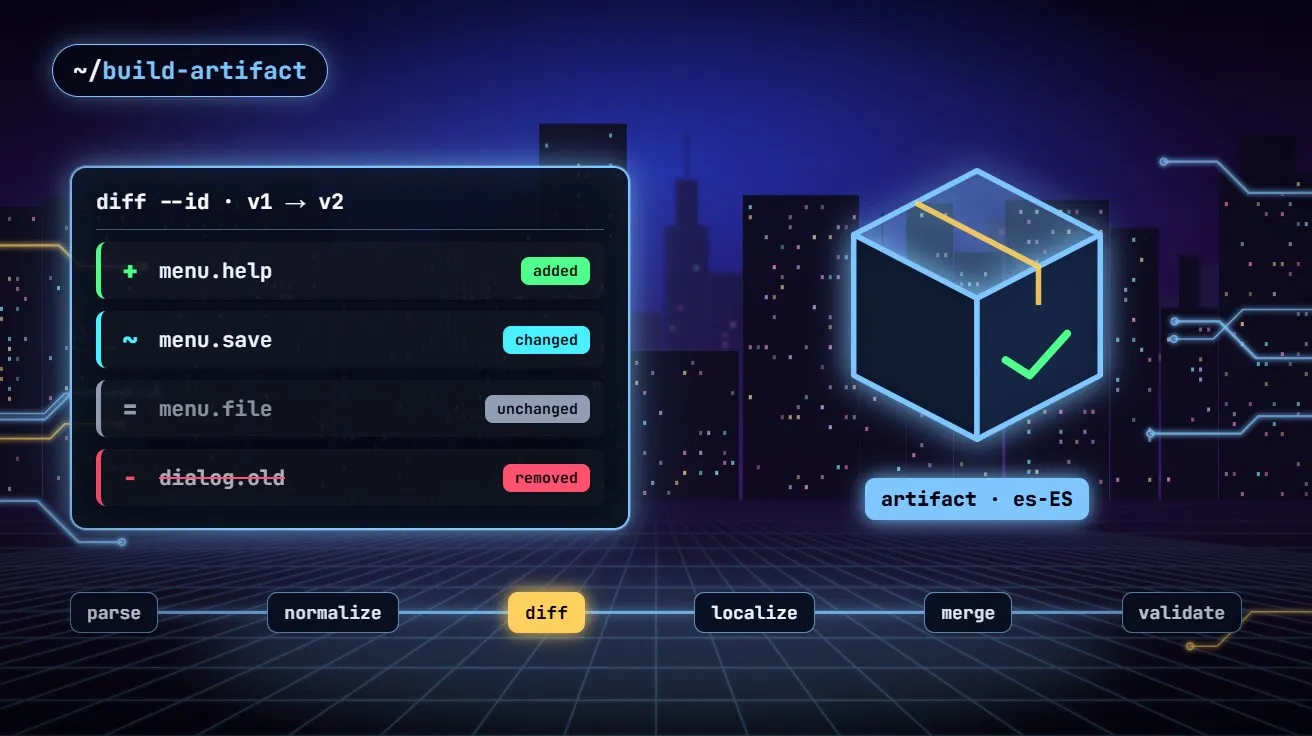
Why the most important thing in a resource file is not the text, and what changes once you stop treating it like a document.
There is a kind of localization problem that looks completely trivial until you have to automate it in production.
You receive a resource file from a client. Three weeks later, development hands you a newer version of the same file. A few strings are new, one or two have changed, something disappeared, and the overwhelming majority are exactly as they were. Your job is to work out which is which, send only the relevant part for translation, and put everything back together without breaking the application.
The traditional answer is to open both versions in a mature localization environment (Passolo, Catalyst, memoQ, Across), update the project and let the software work it out. That answer is correct often enough that most teams never question it.
But the moment you start treating localization as an engineering problem rather than a sequence of clicks, a resource file stops being a document. It becomes an input to a build. And that single reframe changes how you design everything downstream.
A deliberately boring example
Here is a structured resource. It could be JSON, YAML, a .properties file, XML or RESX. The format is not the point.
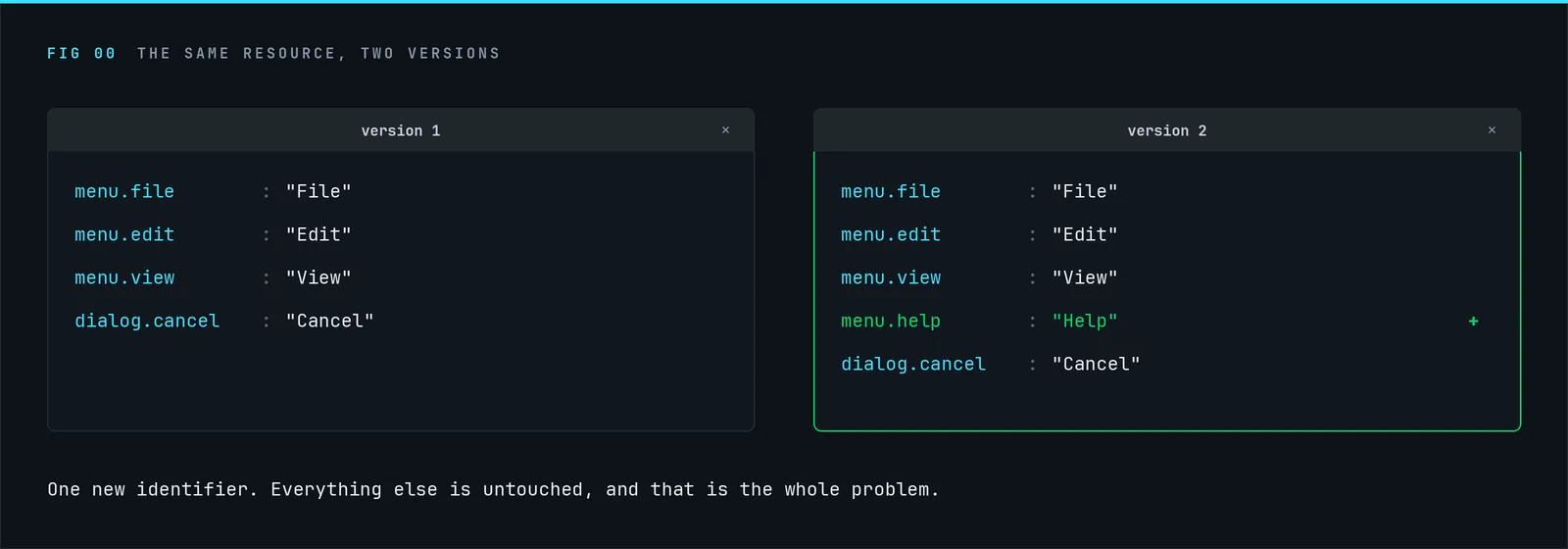
Nothing complicated. One new string, menu.help.
Except that conclusion quietly assumes the only thing we care about is the source text. In a real workflow we care about the persistent identity of each string, its existing translation, its state, its metadata, and precisely what happened to anything that moved or vanished.
The most important piece of information in that example is not the word “Help”. It is the identifier.
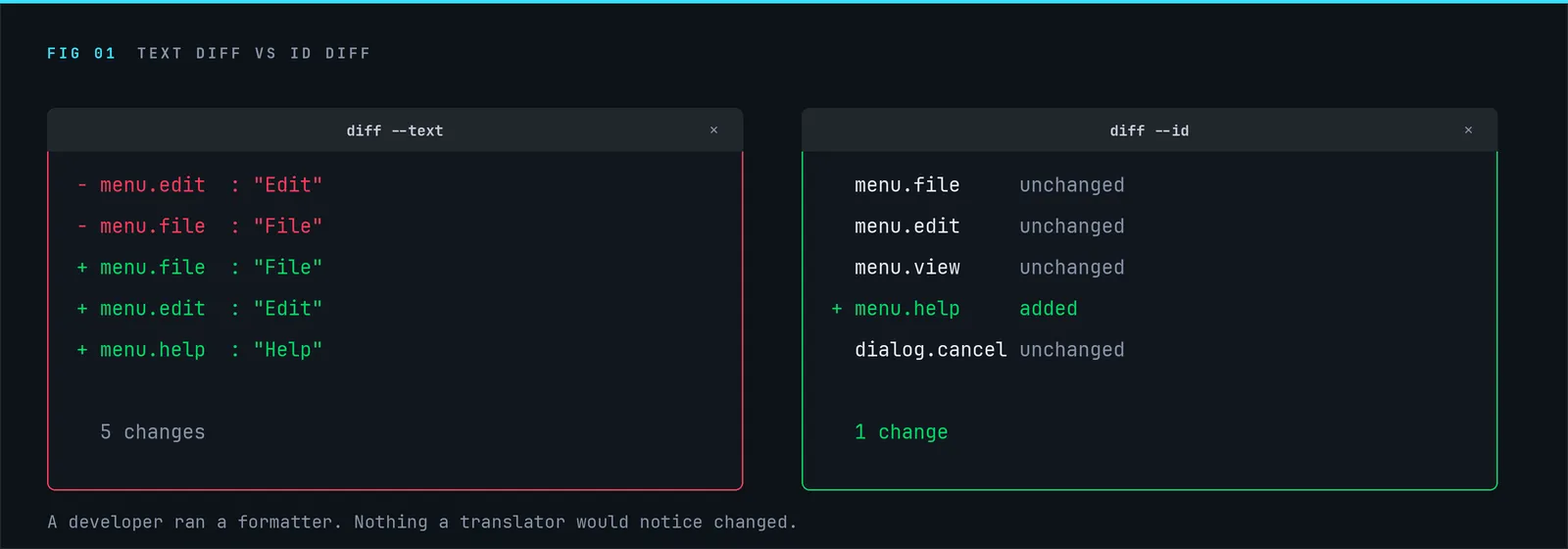
The same two files, compared two ways. Only one of these is true.
Text is not identity
This is the fundamental split between processing a localization resource as text and processing it as structured data.
A human can look at two versions of a file and see immediately that strings were reordered. An automation pipeline cannot, and should not try. Lines move. A code formatter rewrites the indentation. Someone alphabetizes the keys. A developer refactors the file into nested groups without touching a single word of translatable content.
If your pipeline reads the file as a list of text lines, all of that registers as change. You end up sending a thousand units for retranslation because somebody ran a linter.
The correct abstraction is the localization unit: a thing with an identity, a source, a target, a state and some metadata attached to it. For formats that carry key-value structures or explicit attributes (RESX, DITA, properly designed JSON and YAML), the identifier can become the stable key you compare against.
Can, not will. That assumption is doing a lot of work, and it is worth saying out loud what it depends on.
Four states, not two
When identity is stable, a version comparison produces four categories rather than the two most people think about.
Added. The identifier did not exist in the previous version. New content, needs translation.
Changed. The identifier existed, but the source content is different. It needs translation, but you still have the previous translation and the previous source, which means you can show a translator the delta instead of a blank box.
Unchanged. Identifier and source both match. Leverage it, lock it and keep it out of the handoff entirely.
Removed. The identifier is gone. This is the one everybody forgets, and it is the one that causes the strange bugs six months later. Removed units should be archived rather than deleted, because identifiers come back. A feature gets reverted, a screen returns, a key is reused. If you deleted the translation, you pay for it twice.
That fourth category is also a quality signal in its own right. A release where forty per cent of the identifiers disappeared is not a normal release, and your pipeline should be the thing that notices.
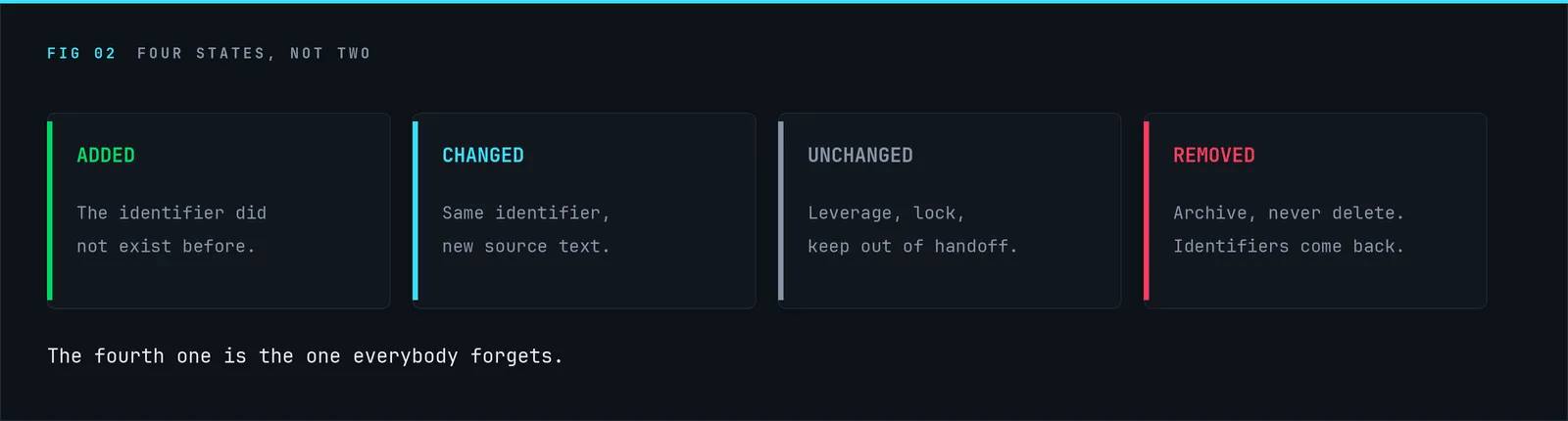
Added, changed, unchanged, removed. Most pipelines only model the first three.
When the identifiers are not stable
This is the obvious objection, and most articles about this topic skip it.
Sometimes the keys are generated. Sometimes they encode the source text, so changing “Delete account” to “Remove account” produces a brand new identifier and silently destroys the relationship you were relying on. Sometimes a well-meaning developer renumbers everything. Sometimes there are duplicate identifiers in the same file, which is not supposed to happen and happens constantly.
You have a few options, roughly in order of preference.
Fix it upstream. Talk to the development team. Stable identifiers cost them almost nothing and save you a recurring tax forever. This is the only real solution, and it is worth spending political capital on.
Failing that, build a composite key. Identifier plus file path plus parent node is often stable even when the raw identifier is not.
Failing that, fall back to content matching, but treat it as a fallback and log it as one. A unit matched by text rather than by identity is a lower-confidence match and should be visible as such in your report.
And if none of that works, accept that you are doing document localization rather than software localization, and stop pretending the pipeline can be deterministic. That is a legitimate answer. It is just a different problem with different tooling.
The engineering decision here is not “which matching strategy is best”. It is “which strategy applies, how do I know which one fired, and what do I do when the good one is unavailable”.
The CAT tool is a component
Once the data can be extracted, normalized, compared and transformed deterministically, something shifts in the architecture.
The localization environment stops being the place where the workflow happens and becomes one component inside a larger process. An important component, with a real job, but a replaceable one.
This is worth being precise about, because it is easy to read as dismissive and it is not. A tool like Passolo or Catalyst is not a glorified text editor. It is a database maintaining relationships between sources, targets, identifiers, states and metadata, with decades of accumulated handling for things you have not thought of yet. That is valuable.
The question is simply where it sits. If the answer is “everything must happen inside it”, every new source format becomes a project to make that tool understand the format. If the answer is “it consumes a well-defined bilingual representation”, every new source format becomes a parser, and the rest of the pipeline is untouched.
The unglamorous part is the actual work
There is a pull in this industry towards the interesting-sounding parts of automation. APIs. AI. Neural MT. Agents, now.
In localization engineering the critical work is profoundly boring.
Encoding. Escaping. Placeholder preservation. Nested structures. Empty values that are meaningfully different from missing values. Duplicate identifiers. Byte order marks. Trailing white space that is significant in one format and noise in another. Round-trip integrity.
A pipeline that works on a clean example file is a demo. A pipeline that survives the files developers actually commit is infrastructure, and the distance between them is made entirely of edge cases nobody wants to write about. Run yours against the ugliest file in the repository, not the one in the documentation.
It is a build
Look at the shape of the process once it is written down.
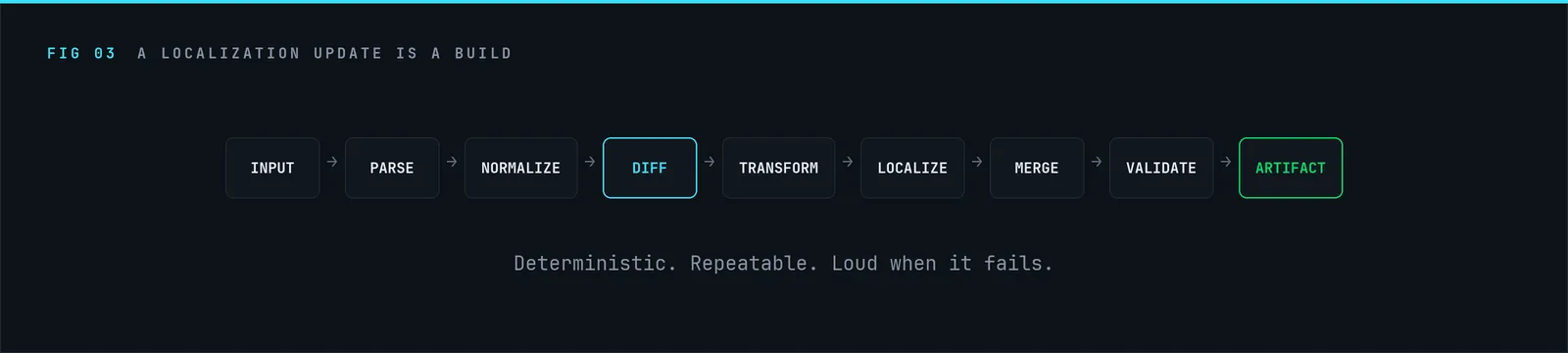
An input, a series of deterministic transformations, and an artifact at the end.
That is a build. It has the same properties a build has: it should be deterministic, it should be repeatable, it should fail loudly rather than quietly, and it should produce the same output from the same input every time. A localization update that cannot be re-run from the same inputs and produce the same result is not a pipeline, it is a ritual.
What the automation is for
The goal is not to remove the engineer.
If a machine can determine with confidence that most of a file is untouched, there is very little value in a human confirming it by hand.
The point is where the human attention goes. Not on verifying the obvious, but on the exceptions, the low-confidence matches, the removed units nobody can explain, and the architecture that keeps producing them.
That is the difference between automating a localization task and engineering a build.
If you want to see the identifier idea at work on real files, ID-based alignment reuses translations by key, and only when the source text did not change.